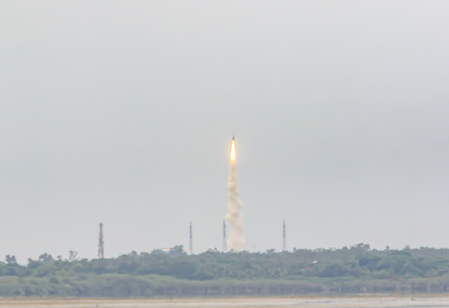
Beijing April 2 (IANS) As Chinese space lab Tiangong-1 re-entered the Earth s atmosphere on Monday burning up in the skies over the central region of the South Pacific residents of the country bid the spacecraft a final farewell.
Regarded as a pioneer of China s future space station the experimental space lab re-entered the Earth s atmosphere at around 8.15 a.m. on Monday Xinhua news agency reported citing the China Manned Space Engineering Office (CMSEO).
"Tiangong-1 has carried millions of Chinese space dream. Although it s only aimed to test the technologies for space station it has many far-reaching effects " Mao Xinyuan a columnist was quoted as saying.
The Tiangong-1 measuring 10 metres long and weighing around 8.5 tonnes was launched on September 29 2011.
The spacecraft was in service for four and a half years two and a half years longer than initially planned making important contributions to China s manned space cause and paving the way for China to become the third country in the world to build a permanent space station around 2022.
"The important role of Tiangong-1 would go down in China s space history. It had helped us accumulate precious experience in constructing space station " said Huang Weifen Deputy Chief Designer of the Astronaut Center of China.
The Tiangong-1 whose name translates as "Heavenly Palace 1 " had previously docked with Shenzhou-8 Shenzhou-9 and Shenzhou-10 spacecraft and was visited by six astronauts including two females.
In June 2013 female astronaut Wang Yaping aboard Tiangong-1 delivered a lecture to students on Earth about physics inspiring public enthusiasm for science and space exploration.
"Although Tiangong-1 was only a transitional platform between the spaceship and space station it s a key step for China to acquire the spacecraft docking technology and it demonstrated the possibility of long-time space residence for the Chinese " said Bai Ruixue a former space journalist and now CEO of a company focusing on public understanding of space science.
"The scientific imagination aroused by it among the Chinese is invaluable " Bai said.
The space lab ended its data service on March 16 2016.
In September 2016 China launched its new space laboratory the Tiangong-2 which hosted its first manned mission with two astronauts on board between October and November Efe news reported.
China plans to start in 2019 the construction of a space station consisting of several modules which is scheduled to conclude in 2022.
NASA s first space station Skylab fell to Earth in an out-of-control re-entry in 1979 burning up harmlessly in the process CNN reported.
The last space outpost to drop was Russia s 135-ton Mir station in 2001 which made a controlled landing with most parts breaking up in the atmosphere.
--IANS
gb/bg