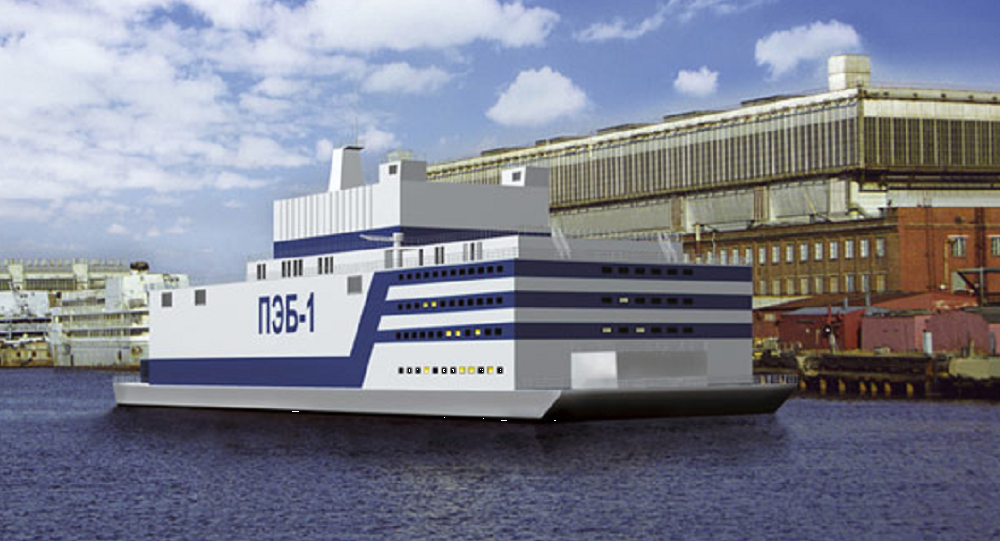
New Delhi May 30 (IANS) Russia is in advanced stages of building the world s first floating nuclear power plant (FNPP) for installation in remote areas and hopes FNPP technology will also interest South Asian countries like India.
Pavel Ipatov Deputy CEO (Special Projects) in Russia s state atomic energy corporation Rosatom told IANS in an e-mail interview from Moscow that an FNPP is basically a mobile low-capacity reactor unit operable in remote areas isolated from the main power distribution system or in places hard to access by land.
FNPPs are designed to maintain both uninterruptible power and plentiful desalinated water supply in remote areas he said.
The Russian explained that floating units are components constructed for transport by sea or river to areas that are otherwise inaccessible or difficult to reach by land.
The plant is constructed as a non-self propelled vessel to be towed by sea or river to the operation site. Its mobility will make it possible to relocate it from one site to another if necessary he said.
The first floating NPP is to operate in Russia s extreme northeastern region of Chukotka where there is plenty of oil and gas exploration gold mining and other mineral resource enterprises he added.
According to Ipatov the vessel s construction is at its closing stage. The plant has already been floated out fitting-out is under way. It has been undergoing mooring trials since last July to test the FNPP s performance efficiency which are scheduled to be completed by October.
After the tests the FNPP called Academician Lomonosov will be transported by Russia s Northern Sea route to the operation site where it will be integrated into the coastal network being constructed in the port of the city of Pevek.
The construction of onshore facilities is under way on the FNPP s future operation site. In 2019 the power unit installation on its proper location is expected to start and then the FNPP will undergo final trials and be put into operation he said.
The FNPP has an electric capacity of 70 MW and is equipped with two reactors of 150 MW thermal capacity each.
A vessel like that can provide electric supply to a city of 200 000 and heat supply to a million-plus city Ipatov said. An FNPP s operational life span ranges from 35 to 40 years.
In line with conventional onshore nuclear plants that are often equipped with desalination units for freshwater the FNPP will have a desalination unit producing up to 240 cubic metres of water per hour.
Besides as regards safety the Russian said that FNPPs would be governed by the same advanced safety parameters put in place after the Fukushima disaster in Japan in 2011.
He cited the example from Soviet times of the first commercial desalination complex attached to a nuclear power plant that went into operation in 1967 providing freshwater supply to the city of Aktau in Kazakhstan.
Now this nuclear plant is inoperative but the desalination plant is still working with alternate heat generation Ipatov said of the project that was implemented by Rosatom.
According to him with Russia s expertise its FNPPs will be in great demand in the global small nuclear power market.
We see significant potential in Southeast Asia and other regions of the world. Memorandums of cooperation on floating nuclear power plants projects have been signed with China and Indonesia he said.
We hope that FNPP technology will also gain interest in South Asia including India not only in terms of new opportunities to provide power supply to remote areas but in terms of building extra seawater desalination facilities too he added.
Rosatom are the builders in collaboration with the Nuclear Power Corporation of India Limited (NPCIL) of the Kudankulam Nuclear Power Project (KNPP) in Tamil Nadu that envisages the construction of six reactors of 1 000 MW capacity each.
While KNPP reactor units 1 and 2 are already connected to the southern power grid the ground-breaking ceremony for construction of units 3 and 4 was done in February last year.
Earlier this month the Indian cabinet approved the setting up of 10 indigenous Pressurised Heavy Water Reactors (PHWRs) for nuclear power generation of around 7 000 MW power.
India currently generates 6 780 MW from nuclear power. Nuclear reactors which will produce another 6 700 MW are under implementation and these are expected to be completed by 2021-22.
(Biswajit Choudhury can be reached at biswajit.c@ians.in)
--IANS
bc/sac
Russia building first floating nuclear power plant