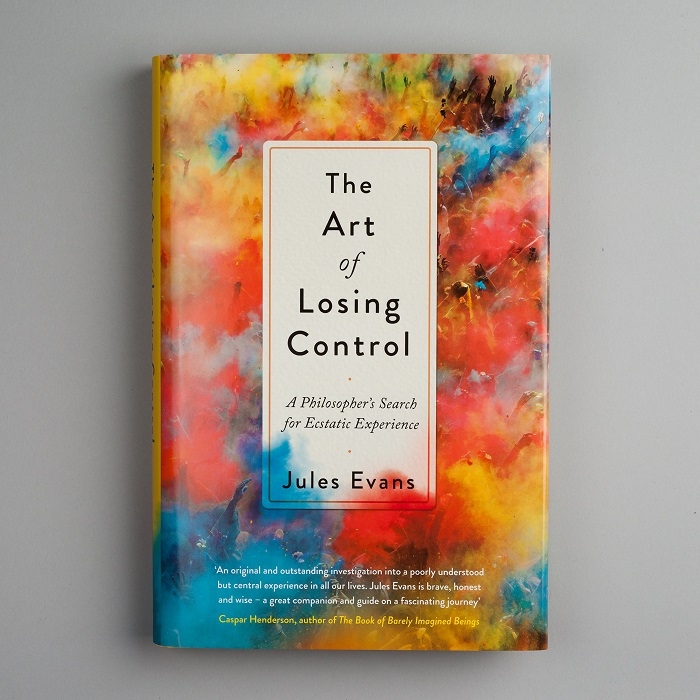
Title: The Art of Losing Control; Author: Jules Evans; Publisher: Canongate; Pages: 294; Price: Rs 699
Even in our hi-tech increasingly self-obsessed and anxiety-besetworld there are times when we move beyond our digital devotion daily duties or angst to a more peaceful absorbed or transcendent state of mind. Do these moments of rapture have any significance beyond a (pleasant) diversion in our ordered world and do we need to have them more regularly? Definitely contends philosopher Jules Evans in this insightful book for they are an integral part of what makes -- and keeps us -- human and functioning properly. While he cites writer Aldous Huxley about the human urge for self-transcendence against their personal existence s inadequacies and psychologist Abraham Maslow s stress on peak experiences going beyond the self he himself makes the best case for them in our present way of life. All of us need to unself. Civilisation makes great demands on us: We must control our bodies inhibit our impulses manage our emotions prepare a face to greet the faces we meet .... Our egos have helped us survive and compete and they do a good job at this by spending every second of the day scanning the horizon for opportunities and threats.... However the problem is says Evans that the self so constructed is isolated cut off by walls of fear and shame besieged by worries and ambitions and conscious of its own smallness and impending mortality. That is why we need to let go every now and then or we get bored exhausted and depressed. But while these infrequent moments of rapture help he seeks to move towards deeper versions of ego-loss or ecstasy as per the ancient Greeks where people feel deeply connected to something greater than them and go beyond any sense of I and you. It is quite a shift for Evans whose first book Philosophy for Life was on the importance of Greek philosophy especially the Stoic which is characterised by self-control and rational self-analysis. But he says that he gave up this approach as it misses a lot out and there is something to be said for those moments when we lose control or surrender to something greater than us. Examining ecstasy at various levels and listing its positives and negatives he also chronicles when and why it fell out of favour especially in the West how it revived -- and got more reviled -- in the 1960s and its current ambivalent status. He then presents 10 varied ways towards its realisation -- from religion to culture and drugs to technology. I ve imagined this book as festival with each chapter as a different tent or zone. Each tent explores a different way that people find ecstasy in modern Western culture. As at a festival in some tents you ll feel at home; others might seem a bit weird but just go with it and see what happens he says. But modern Western culture is a more expansive term than it appears to be -- for his festival has influences from all around the globe including the mystical East. Here you will encounter both Socrates and Shakespeare Dionysus and the Dalai Lama Bruce Springsteen and Steve Jobs LSD guru Timothy Leary to Osho an Indian-Burmese businessman who is posthumously still teaching meditation -- and even bloodthirsty IS operatives. And it has been a personal quest for Evans who in the last four years attended a week-long tantra festival a 10-day Vipassana course in the wilds of Sweden and a charismatic Christian church for an year besides a rock and roll pilgrimage to Memphis and Nashville and discussed elves with a room full of psychedelic scientists among others. Taking an even-handed approach Evans lists both advantages and disadvantages (and even dangers) of these approaches even -- and especially -- technology while enlivening his account with candour wit and his own often exasperated experiences. Ending with his take on how these approaches can be refined he admits he left out quite a few others quipping it is effing difficult to talk about the ineffable. However these -- spanning a large spectrum -- are sufficient to evoke our interest and inspire us to think beyond our insular existences with its unforgiving routines. It could be worth it. (Vikas Datta can be contacted at vikas.d@ians.in) --IANS vd/sac
Searching for ecstasy across a spectrum of transcendence