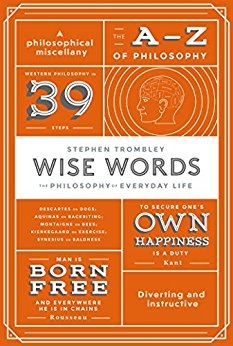
Title: Wise Words - The Philosophy of Everyday Life; Author: Stephen Trombley; Publisher: Head of Zeus; Pages: 337; Price: Rs 599
Our perversity can sometimes be extreme. We look for guidance from every quarter -- leaders temporal and spiritual self-help gurus agony aunts et al -- but ignore those who have selflessly devoted themselves to probing threadbare all facets of the human condition. And unlike perceptions philosophers were not always ivory-tower residents engaged with abstract issues. God is dead but my hair is beautiful said a contemporary practitioner several Greek and Roman scholars devoted their attention to identifying which food was best for humans another recent one termed philosophy a combative sport and drew analogies between it and boxing and a Marxist ended up writing one of the best books on cricket. With these and more American filmmaker musician and author Stephen Trombley provides a wide and varied look at over 25 centuries of Western thought and its practitioners weighing in on expected and unexpected topics and responding to them in their life. Thus views on issues like consciousness dreams happiness God and truth rub shoulders with back-biting day jobs drugs haircuts nicknames sex sport and even walking (an activity several prominent philosophers adored). And all are presented in a retro look with a title page bearing the topic and having five or so rather telling quotations before they are dealt with chronologically and contextually. The aim of this little miscellany is both to amuse and to inform the reader as I have been amused and informed while writing it says Trombley who has edited The New Fontana Dictionary of Modern Thought and previously written A History of Western Thought and Fifty Thinkers Who Shaped the Modern World. Free to choose his topics he notes that while there was some method to his approach whimsy was the chief criterion I employed in deciding what subjects to write about and which philosophers to include. This he says accounts for the opics that might be found in an agony column. Trombley also goes to ascertain the reason for why philosophy has down the ages being transformed from something aimed at helping the people live their life to a rather academic discipline. With his sequence being Greeks Romans scholastic (Medieval era) Renaissance Enlightenment idealist naturalist empiricist analytic continental and other thinkers he contends he begins with the Ancient Greeks not only because they were first in the Western tradition to consider these topics but hey were usually clear in their definition of a problem and its solution. He also goes on to identify when it became woolly unclear and remote explained cogently in the section on obfuscation -- where the approach changed from Socrates who prided himself on making his arguments clear and using ordinary language to the German idealists who started inventing new words and took to writing tortuous sentences that were longer than an Englishman s paragraph... Examples are provided. But apart from this there is much to interest even those who might not have been previously aware of any inclination towards the subject. Take the treatment of duty where the pendulum swung from it being considered one of the key responsibilities of humans to being deemed a concept dangerous to life to a more nuanced approach which stressed on the absence of coercion and the requirement of fairness. Likewise freedom was considered unsuitable in the political system (Plato) the purpose of enlightenment (Kant) a basic ingredient of social order but denied (Rousseau) possible only through communism (Marx) or subverted into epressive tolerance in liberal democracies which prided itself about it (Herbert Marcuse). It is a passage that will provide much food for thought for who those who remember our recent spell of intolerance. And along with all these there are a range of fascinating facts about philosophers ranging from Plato s real name those who were vain obnoxious ungrateful or even murderous -- in short like the people they lived among. Never requiring full-time attention with readers free to peruse through a topic or two (inter-linked with related subjects) at random this engaging work is not only an apt introduction but in its eclectic array of issues and views likely to spur interest and stimulate thinking. What else is philosophy s purpose? (Vikas Datta can be contacted at vikas.d@ians.in) --IANS vd/sac
A wealth of wisdom on human issues expected and unexpected