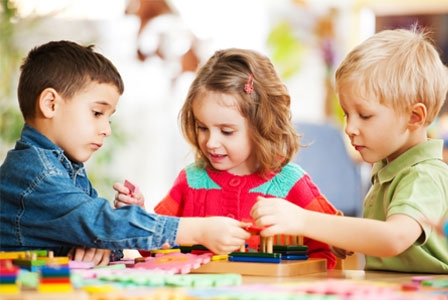
New York July 7 (IANS) Informal teaching methods such as game playing can improve the mathematical abilities in preschoolers especially those living in economically deprived conditions and better equip them for formal school teachings researchers have found.The researchers designed math games intended to help preschool children from disadvantaged families grasp concepts of number and geometry as well as social games to help them cooperate and learn together.The results showed that in the short term the game-based instruction improved both students intuitive mathematical abilities (e.g. numerical estimation) as well as their formal skills (e.g. the recognition of numerals and shapes by their names)."Young children today face a challenge at around age 5: they must transition from learning in a spontaneous informal manner to learning formally in school " said lead author Moira Dillon assistant professor at the New York University. But this transition is particularly difficult especially for children living in poverty and who have parents who did not experience formal schooling themselves. "Our study designs and tests a mathematics games curriculum for such children and is aimed at exercising their intuitive sense of number and geometry in an informal preschool classroom setting to give them the preparation they need to begin formal mathematics learning in school " Dillon added.In the study appearing in the journal Science the researchers included approximately 1 500 children in more than 200 preschools located in some of Delhi s poorest areas.Children who played these math games were compared both to children who received the traditional preschool curriculum and to children who played games that exercised social as opposed to mathematical skills. While improvements to children s intuitive mathematical skills persisted at least a year after the intervention the informal game-based curriculum had no apparent effect on children s later learning of formal mathematics during their first year of primary school the researchers said.--IANSrt/ksk/dg
Games may boost preschoolers mathematical abilities