Music transferred & flourished through sea trades- Rolf Killius
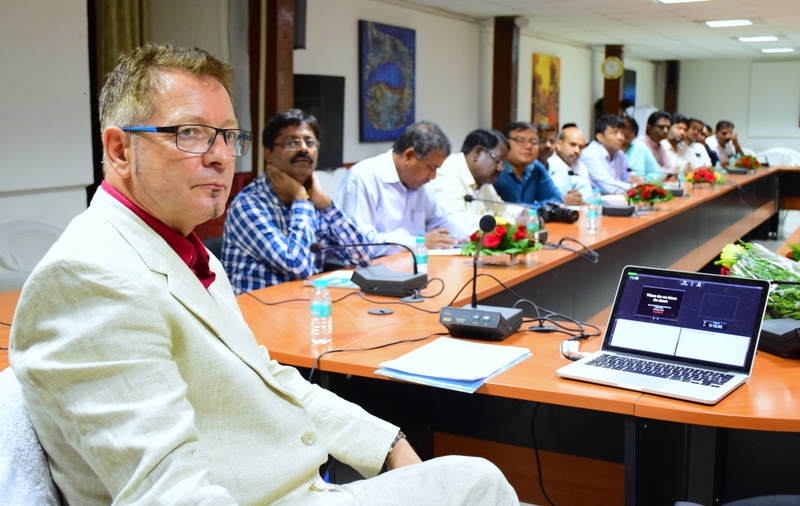
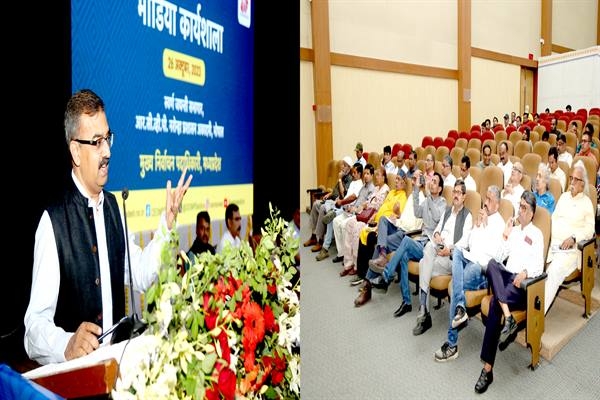
In this lecture Rolf Killius elaborated on the rich traditional music of the Arabian Peninsula and transformation cause of the sea trade routes and inter-ethnic marriages. Shri Killius began his lecture by informing that he is visiting Manav Sangrahalaya after two decades and said "It is one of the rarest places in the world to learn about ethic music, art, architecture, education, and lifestyle and inter- disciplinary studies surrounding the human life".
Shri Killius gave a detailed presentation about his journey through the gulf and tracing the Sea-music to its origination. In this presentation Rolf showcased recordings dating back to early 20th Century, before the oil riches of the gulf region. His research began with the music played in the music clubs and coffee houses of the small towns along the coasts of Kuwait, Bahrain and Iraq in the 1930s and 1940s.
He said "Sea-music is the most-defining musical genre of the Gulf and has numerous influences from Africa and India. Although the times have changed and no Gulf-Arab works nowadays on a ship these music is still alive and practised by the descendants of Arab seamen".
Shri Killius also presented an AV clip from present Baghdad, where he researched on Baghdad Wahid, which talks about the idea of the oneness and uniqueness of the ancient city of Baghdad and its inhabitants.
A member from the audience today asked about 'Iraqi Makam', Shri Killius described it as "Iraqi Makam is a whole performance unlike Hindustani classical where multiple Ragas are used in a complete performance. Makam also consists of some elements of light classical music".
In brief taking multiple illustrations and audio-video clipping he tried to establish how "Musical Expression" can be used ti understand the history of human journey and linkages cutting across the community or boundaries of nation states.-Windowtonews