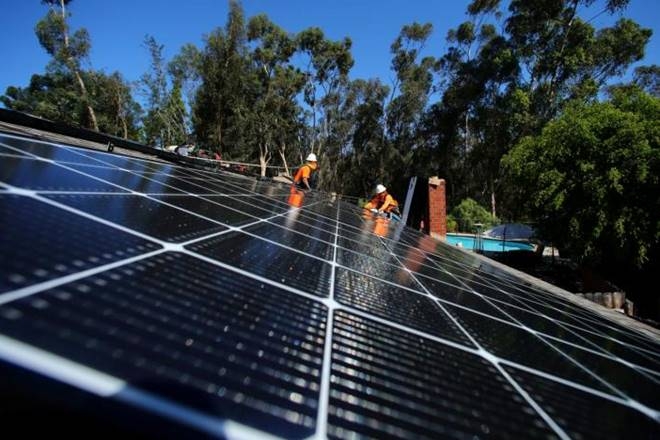
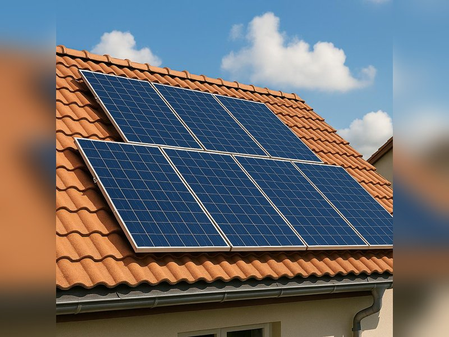
India might be playing a leadership role in bringing the world together for the International Solar Alliance but it is struggling with the adoption of solar rooftops in its metro cities a recent study has shown.
Despite friendly policies and net metering guidelines in several states and a subsidy of 30 per cent offered by the Ministry of New and Renewable Energy (MNRE) the installation of solar rooftop systems has been dismal in leading metros in the country especially in Chennai and Mumbai according to the study.
According to the study titled Indian Cities Slacking on Rooftop Solar Delhi which offers metered connections and a generation-based subsidy in its solar policy has also failed to shine.
The study by Greenpeace India says that while the country has made good progress in reaching its 60 GW utility scale solar electricity targets deployment is particularly slow in the residential rooftops sector. The government has earmarked 40 GW as the rooftop solar target by 2022 but as of December 2016 only over 1 GW worth of installations have taken place.
Delhi which has a current estimated solar potential of 1.25 GW in buildings and has an official target of installing 1 GW by 2020 and 2 GW by 2025 has installed only 35.9 MW of solar rooftop capacity. Out of this only 3 MW is from residential installations.
Mumbai has also been slow in installing solar rooftops in residential buildings. Out of 1.72 GW estimated solar potential as calculated by the Indian Institute of Technology Bombay the city has installed only 5 MW of residential solar.
Tamil Nadu which offers Rs 20 000 subsidy for domestic consumers under the Chief Minister s Solar Rooftop Capital Incentive Scheme has also not been able to make significant progress. The state has a rooftop solar target of 350 MW but not even 2 MW have been installed.
Despite the national incentive in the form of a 30 per cent capital subsidy and a range of state incentives and schemes rooftop solar is yet to take off in the same manner as large-scale solar. However this does not mean India should lower its ambitious targets as some have suggested. Rather the government must step up and play a more proactive role in encouraging rooftop installations said Pujarini Sen Climate and Energy Campaigner Greenpeace India.
As the convenor and a founding member of the International Solar Alliance and a country with abundant solar potential India s commitment to clean energy must continue to be robust.
A Greenpeace poll showed significant public interest in adopting solar power. Close to 55 per cent of the 812 participants expressed willingness to invest and install solar. Despite this interest awareness and various incentive schemes the thrust on solar rooftops has largely been in the government institutional and commercial buildings as opposed to homes.
The report cites lack of familiarity with the process and fear of bureaucratic red tape as the main reasons for the slow uptake of solar rooftops in the residential sector. Other reasons are insufficient knowledge among citizens about the financial incentives and attractive return-on-investment perception that large upfront capital investment is required and ineffective implementation of net metering in various states.
If central and state governments are serious about boosting solar they must do a better job of reaching out to resident welfare associations and community groups to encourage people to shed their inhibitions and embrace rooftop solar said Sen.
However the challenges on the ground are more complex. Developers stress that there is a problem of lack of uniform roofs in the country and the fact that roofs are often used for various purposes that doesn t leave enough space to install big panels. A 10 KW solar plant that can power three air-conditioners and is sufficient for a three-bedroom apartment needs around 1 000 sq. ft. of terrace area.
Ved Prakash Goyal an advisor to Applied Solar Power Management part of the ENGIE group the largest utility company in the world said: In India everyone puts the water tank on the south side of the roof and it is the direction where you get maximum solar energy. Plus you have various things on roofs which reduces the available area needed for solar.
The government has also announced putting 18 per cent tax on solar panels under the new Goods and Services Tax (GST) regime though this number may be revised. While industry feels the currently proposed tax rate will increase cost of solar projects by 12 per cent Goyal says that this will not be an impediment as far as solar rooftops are concerned.
The prices of solar modules are going down and it is expected that they might further decrease by roughly five per cent in the next six months so may be the net effect of GST would be one per cent. In any case solar energy is becoming cheaper to install and the time is ripe for the government to do the needful to boost it further. With the right steps I can foresee a boom in residential solar rooftops in the next two years.
India where there is an issue of both land availability and air pollution is also a country with over 300 million buildings and as many rooftops.
(In arrangement with indiaclimatedialogue.net with whom Juhi Chaudhary is Special Correspondent. Views expressed are those of indiaclimatedialogue.net. Feedback at information@indiaclimatedialogue.net)
--IANS
juhi/sac
No uptake for rooftop solar in Indian cities