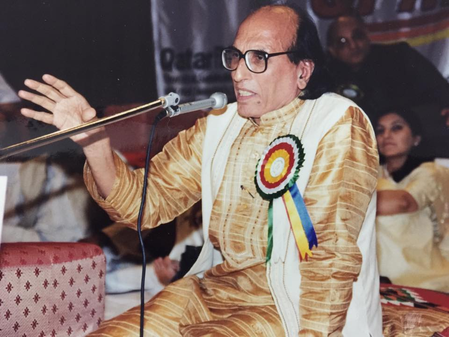
Kolkata Nov 15 (IANS) Prominent Bangladeshi filmmaker and writer Tanvir Mokammel whose latest documentary the crowd-funded "The Borderline" ("Seemantorekha") is shaped by human narratives of the 1947 partition of Bengal says the historical event has "enhanced distance and animosity" among the people of the subcontinent.
The recipient of Ekushey Padak Bangladesh s second-highest civilian award avers that instead of sweeping problems under the rug the past needs to be acknowledged and faced "objectively" so that "we can move on in future in harmony".
"It was said that partition would reduce disharmony and conflict between the two communities the Hindus and the Muslims. But partition has rather enhanced distance and animosity among the people of this subcontinent. If we want to build a peaceful and solvent South Asia the issues related to partition have to be dealt with " Mokammel told IANS in an email interview.
The multiple winner of Bangladesh s National Film Awards spoke about the resilience of the legacy of partition and its relevance emphasising that its impact has been "increasing".
"The subject matter of the film is to depict the 1947 partition in all its different manifestations. But the human stories remained the main focus. Hence the refugees from both sides and whoever have been affected by the partition were our subjects " Mokammel said.
Acclaimed for historical and political commentaries through films like "The River Named Modhumoti" (a deconstruction of "Hamlet" in the backdrop of Bangladesh s 1971 Liberation War) and "Quiet Flows the River Chitra" (plight of a Hindu family which after partition refused to migrate from the then East Pakistan now Bangladesh) Mokammel was driven to work on the documentary by a compulsion to portray as a Bengali artist the "unfathomable" human sufferings of Bengal.
"We the people of Bangladesh and West Bengal are still suffering from the legacy of partition. Millions of families have been forced to migrate and have suffered immensely " he said.
In his over three decades of filmmaking and writing ("A Brief History of World Cinema" "The Art of Cinema" "Charlie Chaplin: Conquests of the Vagabond") the 62-year-old has devotedly addressed critical issues plaguing his country -- the aftermath of partition Liberation War riparian issues and the like.
"Teardrops of Karnaphuli" (Karnaphulir Kanna) (2005) a documentary on the plight of the Chakma Marma Tripura Mrung and other indigenous people of the politically disturbed Chittagong Hill Tracts was banned by the then Bangladesh government.
It was shown in the Kathmandu documentary film festival and in Musee Guimet France.
The 144-minute-long "Seemantorekha" was a culmination of three years of painstaking research. Besides research paucity of funds was another major challenge he said adding that crowd-funding came to his rescue.
"For a non-commercial venture like Seemantorekha it is almost impossible to obtain a producer in Bangladesh. So we commenced the shooting of the documentary with our own meagre resources.
"As our resources ran out we made an appeal for crowd-funding. It worked. Many people contributed to the film. A couple from the US Dr. Debashis Mridha and Chinu Mridha contributed the lion s share " he said.
The lessons to be learnt from partition are manifold he opined stressing on tolerance and pluralistic identities.
"First that you cannot change your geography or your neighbour. So it is imperative for the dominant communities of this subcontinent to learn to be tolerant to learn to live in peace and harmony with each other. You cannot make a garden with only one kind of flower " he said.
"One has to accept the plurality and diversities of the people of South Asia."
There will be differences in religious beliefs rituals social norms and practices he contends but "we have to look not for the differences but to seek and find the elements which unite us to find unity in diversity".
"Only then will our subcontinent be truly rich -- materially culturally and aesthetically " Mokammel maintained.
(Sahana Ghosh can be contacted at sahana.g@ians.in)
--IANS
sgh/ssp/vm/ky/tb